UK food price inflation ran at 5.1% in the year to September 2025 (BBC, citing ONS data), with beef, butter, milk and chocolate all surging. For a restaurant operating on tight margins, every percentage point of ingredient inflation flows directly to the bottom line unless stock is controlled. Yet WRAP, the UK’s waste advisory body, estimates that the hospitality and food service sector throws away around 1.1 million tonnes of food a year (Institute of Hospitality), costing the industry £3.2 billion annually – roughly £10,000 per outlet (WRAP Guardians of Grub).
Inventory management is the bridge between those two numbers. Done well, it protects food quality, prevents shortages, cuts waste and gives the kitchen the data it needs to price menus profitably. Done badly, it leaks profit quietly through over-ordering, spoilage and inaccurate portioning. With CPIH inflation at 3.3% in August 2026 (ONS) and food prices still volatile, this guide covers how to manage restaurant inventory in a way that is practical for UK operators and grounded in current industry data.
Why Inventory Management Matters for Restaurants
Stock control touches almost every other cost in a restaurant. When you know what is in the kitchen, what is selling and what is being thrown away, you make better decisions in four areas:
- Reduce food waste by ordering what the kitchen actually needs, not what it habitually orders
- Prevent stock shortages that take dishes off the menu mid-service
- Improve purchasing decisions by tracking supplier prices and adjusting orders
- Maintain consistent menu quality by ensuring fresh ingredients are always available
With UK food prices still volatile, the restaurants that survive are the ones that treat stock as cash on the shelf – because that is exactly what it is.
How to Create a Restaurant Inventory Management System
A structured system beats a memory-based approach every time. The choice is between a manual spreadsheet and dedicated restaurant inventory software – and the right answer depends on the size of the operation.
Choose an Inventory Tracking Method
Smaller restaurants and single-site operations often start with spreadsheet-based tracking in Excel or Google Sheets. This is low cost and flexible, but it relies on discipline and manual data entry. For larger or multi-site operations, restaurant inventory software such as MarketMan, Lightspeed Restaurant or Growyze automates the process and integrates directly with the POS – every dish sold instantly deducts ingredients from stock. For more on the technology stack that supports this, see ChefOnline’s guide to the must-have tech tools for restaurants.
Create a Restaurant Inventory Checklist
Every stock record, whether on paper or in software, should capture the same six fields:
- Ingredient name with a consistent naming convention
- Quantity available in the unit you actually count (kg, litres, each)
- Unit cost from the most recent invoice
- Supplier details so you can compare alternatives
- Expiry dates for perishable lines
- Reorder levels – the minimum stock that triggers a new order
Implement a Regular Stock Taking Process
Industry guidance is consistent: a full physical stocktake should happen weekly or fortnightly for all items, with high-value lines counted daily. As we covered in our guide to the future of restaurant technology, digital stocktaking tools make this rhythm realistic for even the smallest kitchens. The structure most UK operators use:
- Daily – high-value items such as meat, fish and alcohol
- Weekly – full dry goods, fridges and freezers
- Monthly – complete stocktake reconciled against sales and invoices
Steps for Accurate Restaurant Stock Taking
- Assign one responsible team member per count to keep records consistent
- Count items the same way each time – same order, same units
- Record actual quantities, not expected ones
- Compare usage against sales data to spot discrepancies
- Investigate variances over a set threshold – usually more than 1–2%
Best Practices for Kitchen Inventory Management
Organise storage areas so counting is fast and visible. Label every delivered item with the date received. Count high-value ingredients at the start and end of each service. Monitor expiry dates daily and rotate stock automatically using FIFO.
Reduce Food Waste Through Better Inventory Control
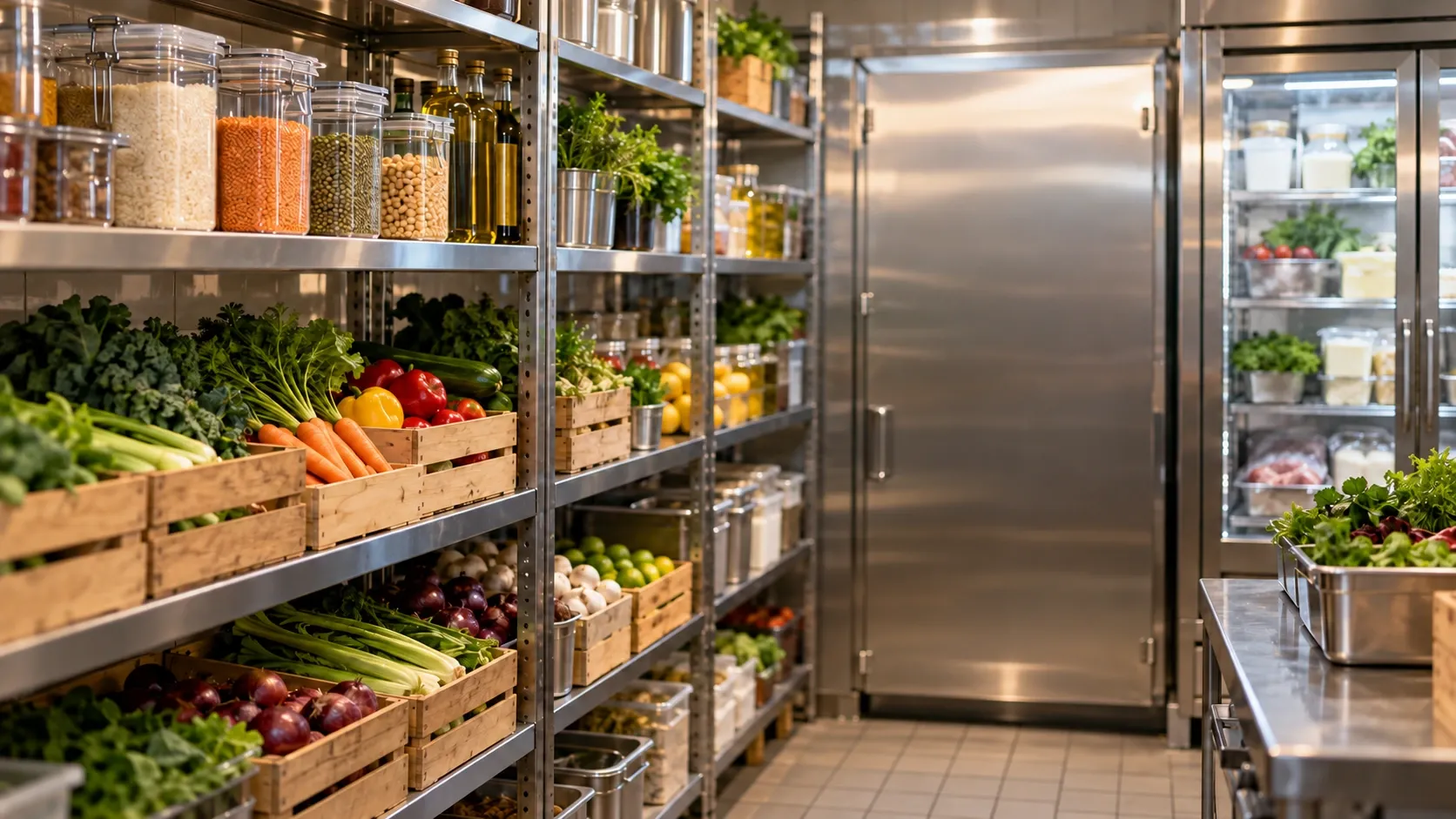
A well-organised walk-in fridge with labelled shelves is the foundation of FIFO and waste control.
WRAP estimates that food waste costs the average UK hospitality outlet around £10,000 per year (WRAP Guardians of Grub). Most of that waste is preventable – the result of over-ordering, poor rotation and inaccurate forecasting. Cutting waste is also a sustainability commitment: every tonne of food saved is a tonne of carbon not emitted.
Use the FIFO Food Storage Method
First In, First Out (FIFO) means older stock is always used before newer stock. New deliveries go to the back of the shelf; existing stock moves forward. As Fourth and myPOS both confirm, FIFO is the single most effective, low-cost tool a kitchen has for reducing spoilage. Apply it to dry stores, fridges and freezers – and label every container with the date received so rotation is visible at a glance.
Track Food Waste Patterns
Keep a simple waste log – a clipboard by the bin is enough to start. Record what was thrown away, why, and in what quantity. After a few weeks you will see patterns: specific dishes that consistently generate trim waste, ingredients that spoil before they are used, or portion sizes that are too large. Adjust purchasing and prep accordingly.
Improve Restaurant Food Cost Management
Inventory control feeds directly into food cost percentage – the metric that tells you whether your menu is profitable. UK industry benchmarks put the target food cost for casual dining at 28–32% of food sales, with gastropubs running slightly higher at 30–35%. For a deeper dive into how stock affects the bottom line, see our guide to calculating the profitability of your restaurant.
Calculate Food Cost Percentage
The formula is simple:
Food Cost Percentage = (Food Costs ÷ Food Sales) × 100
Run the calculation weekly, not monthly. If your percentage drifts above 32% in casual dining, you are either over-ordering, over-portioning, or under-pricing – and only accurate stock data will tell you which.
Prevent Inventory Loss
- Reduce over-ordering by basing orders on sales data, not habit
- Monitor portion control – a free extra scoop of chips is inventory walking out the door
- Identify theft or inaccurate recording through unexplained variances
- Improve staff accountability by assigning ownership of specific stock areas
Use Restaurant Inventory Software and Technology
Modern inventory software removes the manual work of counting, recording and reordering. It also gives managers real-time visibility of stock across multiple sites. The biggest efficiency gains come when inventory software integrates with your EPOS (Electronic Point of Sale) system – every dish rung through the till instantly updates stock levels, food cost data and reorder triggers, with no manual entry required.
Features to Look for in Inventory Software
- Real-time stock tracking
- Automated reorder alerts when stock falls below minimum levels
- Supplier management with price comparison across invoices
- Reporting dashboards showing food cost percentage and waste trends
- POS / EPOS integration – MarketMan integrates with Lightspeed, Revel and Clover, while most modern inventory platforms connect directly to leading EPOS systems so every sale deducts ingredients from stock in real time
Benefits of Digital Restaurant Stock Control
Automation saves management time, improves forecasting accuracy and reduces the human errors that creep into manual spreadsheets. Over a year, the time saved on stocktaking and the reduction in over-ordering usually pays for the software several times over.
Manage Restaurant Suppliers and Ordering Efficiently
Supplier relationships directly affect your inventory costs. A reliable supplier with consistent quality and stable pricing is worth more than a cheaper one who is intermittently unavailable.
Create Effective Ordering Procedures
- Set minimum stock levels for every ingredient
- Review sales trends before placing each order
- Order to demand, not to habit
- Avoid unnecessary bulk purchasing – a 10% volume discount is wiped out if 15% spoils
Monitor Supplier Performance
Track four things for every supplier:
- Delivery reliability – on-time rate and short-delivery rate
- Product quality – rejected batches and returns
- Pricing changes – especially during inflationary periods
- Seasonal availability for fresh produce and seafood
Train Restaurant Staff on Inventory Management
Every team member in the kitchen affects inventory accuracy. Training is not a one-off – it needs to be embedded in the daily routine.
Staff Responsibilities
- Correct food storage following FIFO principles
- Accurate stock recording at every count
- Reporting damaged goods immediately, not at the end of the week
- Following rotation systems consistently across shifts
Build an Inventory Management Culture
Make stock control part of daily routines rather than a weekly chore. Assign ownership of specific storage areas to specific staff. Encourage accountability by sharing variance data with the team – when people see the numbers, behaviour changes.
Common Restaurant Inventory Management Mistakes to Avoid
Ordering Too Much Stock
Bulk buying feels cheaper but causes spoilage, ties up cash flow and creates storage problems. Order to demand, not to discount.
Not Tracking Waste
Untracked waste is hidden profit loss. Without a waste log, you cannot identify which dishes or ingredients are bleeding margin.
Inconsistent Stock Counts
Skipping counts or changing the method each week produces unreliable data. Bad data leads to bad ordering decisions – the very thing stock control is meant to prevent.
Restaurant Inventory Management Checklist
Use this actionable checklist to keep stock control on track:
- Conduct regular stock counts – daily for high-value, weekly for all items
- Update inventory records immediately after every delivery and count
- Check expiry dates daily and rotate stock
- Apply FIFO rotation across all storage areas
- Review supplier prices monthly and benchmark alternatives
- Track food waste with a simple log
- Analyse food costs weekly against the 28–32% benchmark
- Adjust ordering levels based on sales trends and seasonal demand
Conclusion
Restaurant inventory management is not glamorous, but it is the discipline that separates profitable kitchens from struggling ones. With UK food prices still volatile and hospitality food waste costing the sector £3.2 billion a year, the operators who control stock are the ones who protect margin.
Start with the basics: a weekly count, a FIFO system, a waste log and a food cost percentage calculated every week. Add inventory software when manual systems start to creak. Train staff to treat stock as cash. Do these things consistently and the numbers take care of themselves. To dig deeper into the financial side, see ChefOnline’s guide to calculating the profitability of your restaurant, or explore ChefOnline’s wider restaurant digital marketing services for independent UK operators.